56% of Voters Would Consider a New Independent Party That Focuses on Keeping the U.S. Out of Foreign Wars, While 49% Would Consider an America First Party
Voters were asked how likely they would be to consider voting for the candidates of a new America First party, separate from the Republican Party, and of a new independent party, separate from both the Republican and Democratic parties, if either ran candidates for Congress with a focus on keeping the U.S. out of foreign wars. They were also asked whether it is more important that the party they support wins or that the rules are followed. The questions were part of The Honest Poll's final national tracking survey before the November 3 midterm elections, which found Democrats leading the generic congressional ballot by 13 points among Likely Voters. The national House vote showed a Democratic lead of 14.1 points as of November 22, according to the Cook Political Report.
A new national survey by The Honest Poll finds that 56% of Registered Voters would consider voting for the candidates of a new independent party that focuses on keeping the U.S. out of foreign wars, including 19% who say they are very likely to and 37% who say somewhat likely. Twenty-nine percent (29%) say they are not likely to, including 10% who say not at all likely, and 16% are not sure. For a new America First party, 49% would consider voting for its candidates, including 14% who say very likely and 35% who say somewhat likely, while 35% say they are not likely to, including 14% who say not at all likely, and 16% are not sure. Among Likely Voters, 56% would consider the independent party and 49% would consider the America First party.
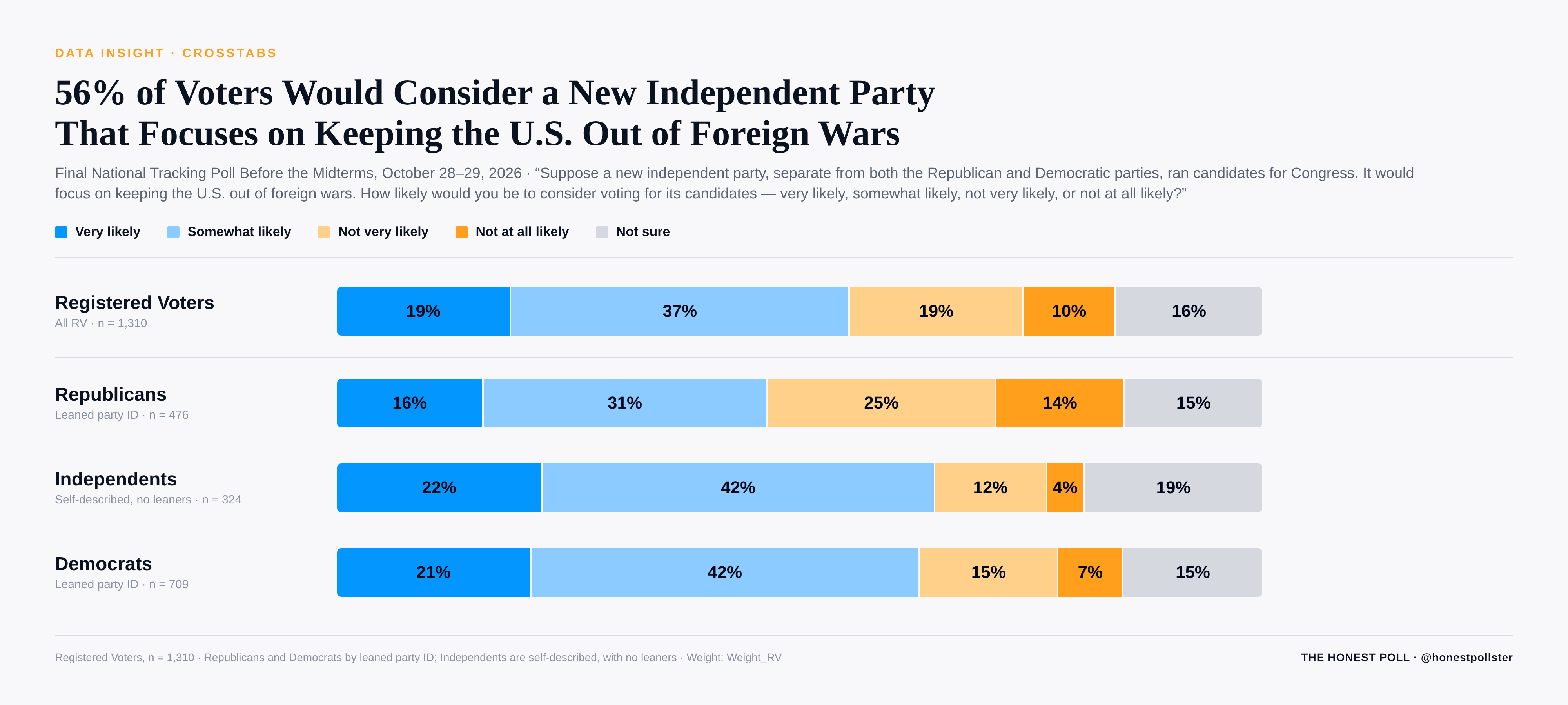
The gap between the two options comes mainly from Democrats and independents. Sixty-three percent (63%) of Democrats would consider the independent party, compared with 52% who would consider the America First party, and 64% of independents would consider the independent party, compared with 54% for the America First party. Republicans are close to even, at 47% for the independent party and 44% for the America First party, as are voters who say they voted for Donald Trump in 2024, at 46% for each. Voters who say they voted for Kamala Harris would consider the independent party 62% to 51%. Liberals would consider the independent party 60% to 47%, moderates 62% to 57% and conservatives 45% to 42%.
Views of the president's job performance and motivation for voting for Congress show the same pattern. Voters who strongly disapprove of Trump would consider the independent party 63% to 52%, and those who somewhat disapprove would consider it 67% to 60%, while voters who strongly approve are at 29% and 28% and those who somewhat approve are at 53% and 52%. Voters who say their vote for Congress is mainly a vote to oppose Trump would consider the independent party 65% to 52%, while those who say it is mainly a vote to support him are at 42% for the independent party and 44% for the America First party, and those who say it is not mainly about Trump are at 54% and 50%.
Younger voters are the most open to both options. Seventy-three percent (73%) of Generation Z would consider the independent party and 64% would consider the America First party, compared with 60% and 52% of Millennials, 56% and 49% of Generation X, and 43% and 37% of Baby Boomers. Among men under 40, 71% would consider the independent party, including 31% who say very likely, and 64% would consider the America First party, including 25% who say very likely. Women under 40 are at 65% and 54%, men 40 and older at 48% and 42%, and women 40 and older at 50% and 44%. Hispanic voters would consider the independent party 60% to 53%, Black voters 62% to 56% and White voters 54% to 47%.
Voters in households earning $35,000 to $65,000 a year would consider the independent party 60% to 52%, compared with 53% to 45% in households earning $100,000 to $150,000. Voters with a graduate degree would consider the independent party 49% to 36%, while voters with a high school diploma are at 63% and 57%. Voters who work for a private company would consider the independent party 61% to 51%, and the self-employed are at 66% and 63%. Voters who say they are less enthusiastic than usual about this year's midterm would consider the independent party 64% to 55%, compared with 56% to 49% among those who are more enthusiastic. By region, the independent party is at 58% in the Northeast, 56% in the South, 54% in the Midwest and 53% in the West, and the America First party is at 51%, 50%, 47% and 47%.
The two groups of supporters overlap. Among voters who say they would consider the independent party, 77% would also consider the America First party, while 88% of those who would consider the America First party would also consider the independent party.
Seventy-six percent (76%) of Registered Voters say it is more important that the rules are followed, even if the party they support loses, while 10% say it is more important that the party they support wins, even if that means bending some rules. Eight percent (8%) say they do not support any party and 6% are not sure. Among Likely Voters, 78% say the rules and 10% say the party winning. Republicans say the rules 78% to 11% and Democrats say the rules 77% to 10%, while 20% of independents say they do not support any party. The share saying the party winning is more important is 18% among Hispanic voters and 17% among Black voters, compared with 7% among White voters, and 16% among Generation Z compared with 5% among Baby Boomers. Voters who say the party winning is more important would consider the independent party 69% and the America First party 60%, compared with 55% and 49% among those who say the rules.
Never miss a poll.
Get free notifications the moment we publish. Topline results, no spin, no narrative — just the numbers.
The survey of 1,310 Registered Voters, including 1,158 Likely Voters, was conducted October 28-29, 2026, by The Honest Poll, combining an online panel with an SMS text survey, weighted to match known demographic and political benchmarks. The margin of sampling error for the full sample is +/- 2.9 percentage points at a 95% level of confidence; the margin of error is higher for subgroups, including independents and age-by-gender groups.